• About
  • Privacy Poilicy
  • Disclaimer
  • Contact
CoinInsight
  • Home
  • Bitcoin
  • Ethereum
  • Regulation
  • Market
  • Blockchain
  • Ripple
  • Future of Crypto
  • Crypto Mining
No Result
View All Result
  • Home
  • Bitcoin
  • Ethereum
  • Regulation
  • Market
  • Blockchain
  • Ripple
  • Future of Crypto
  • Crypto Mining
No Result
View All Result
CoinInsight
No Result
View All Result
Home Ethereum

L2 growth and $120 billion in staking hide Ethereum’s supply reality

Coininsight by Coininsight
September 22, 2026
in Ethereum
0
189
SHARES
1.5k
VIEWS
Share on FacebookShare on Twitter

Related articles

Ethereum bears keep selling but ETH price stays near $2,700 as US spot ETFs record $206M in outflows

October 7, 2026

How native transaction assertions could enforce a transaction’s final outcome

October 5, 2026


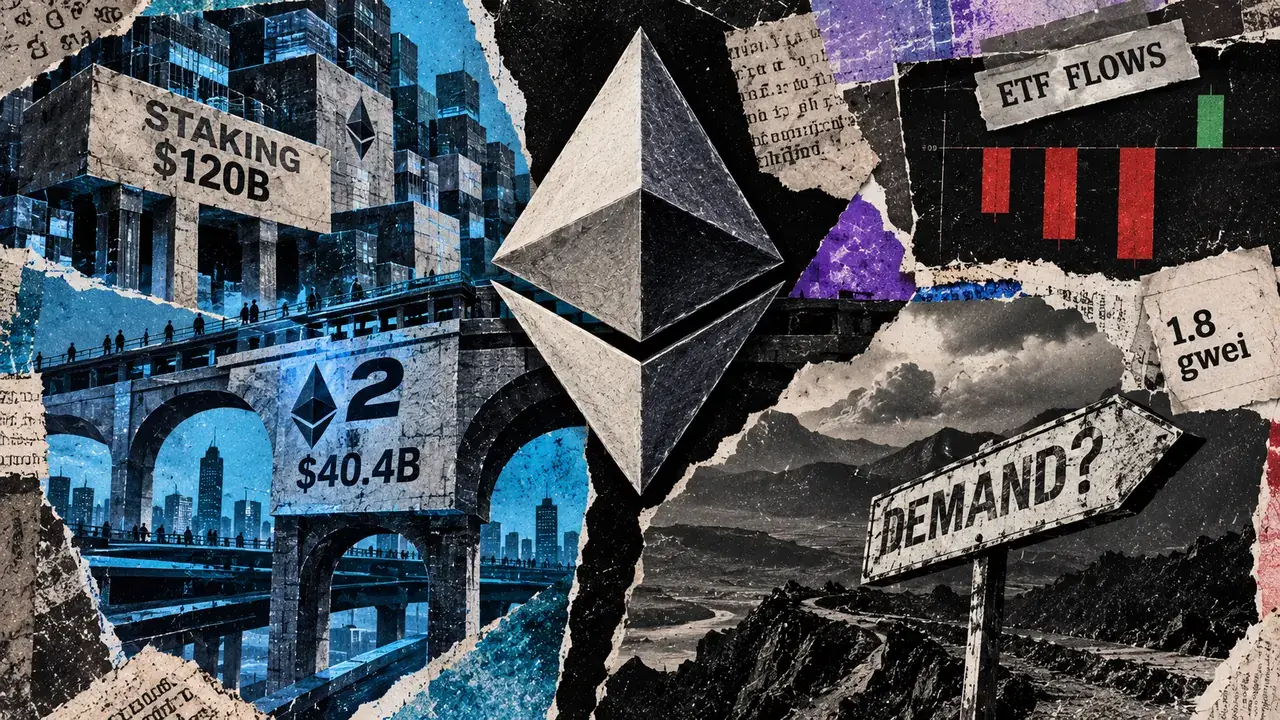
Ethereum’s institutional data hub showed about $120 billion in staked ETH and $40.4 billion in daily average total value locked on layer-2 (L2) networks in a Sept. 21 snapshot.

They measure different things: ETH committed to network security and assets held across L2 networks, so adding them together would not measure fresh ETH demand.

Meanwhile, US-traded Ethereum ETF sessions saw over $140 million in net outflows from Sept. 15 to 18. Large pools of staked ETH and assets on Ethereum-linked networks can coexist with investors pulling money from a particular investment channel.

A staking balance is not a purchase receipt

Staking involves depositing ETH to activate validators, which help secure Ethereum and earn rewards.

An owner can stake ETH already held, resulting in staking participation. Yet, they could also acquire ETH specifically to stake it, so the result is not necessarily fresh demand in all cases.

A staking balance expressed in dollars reflects both the ETH committed and its valuation, so it should not be read as the amount of new capital investors supplied during a particular day or week.

Liquid staking tokens can represent deposited ETH and allow holders to transfer that exposure. The underlying stake remains committed to validation, while the holder may retain a route to liquidity.

For investors, the key question is how much ETH was acquired before being staked. Farside Investors’ Ethereum ETF table provides a dated view of one investment channel.

Last week started with $121.1 million in inflows on Sept. 14, then the funds bled $405.4 million from Sept. 14 to Sept. 17. US-traded spot Ethereum ETFs closed the week on Sept. 18 with $143.7 million in fresh inflows.

ETF flows also cannot settle the question of total ETH demand, as they only describe movements through those funds.

The Catalyst

What’s moving crypto. Why it matters.

Get CryptoSlate’s essential stories and what to watch next.

Published on Substack

Seven days a week. Unsubscribe anytime.

Whoops, looks like there was a problem. Please try again.

Check your inbox.

Your signup request was sent. If confirmation is required, follow the email from Substack.

Look in spam or promotions if you don’t see it.

Related Reading

BlackRock’s staking Ethereum ETF pays yield but investors still prefer its $9 billion ETHA fund

L2 assets and Ethereum fees are different measures

The $40.4 billion L2 figure measures assets on the networks, while the connection to ETH holders runs through what those networks actually pay for Ethereum’s services.

L2BEAT’s on-chain-costs measure tracks operator payments for posting transaction data, proofs, and state updates. Its breakdown includes calldata, blobs, compute, and overhead. Those costs differ from the fees users pay directly to an L2, and blob spending alone does not represent the whole settlement bill.

Even total operator spending is not identical to ETH burned. Ethereum’s execution base fee is burned, while priority fees go to validators. Blob fees operate in a separate market and are also burned.

That distinction prevents a simple leap from rising L2 activity to a proportional benefit for every ETH holder. Assets held, fees charged to users, payments to Ethereum, and supply reduction are separate measurements.

Ultrasound.money displayed 1.8 gwei in its gas header on Sept. 21. Lower execution base fees mean less ETH burned per unit of gas consumed, other things equal. They can also reflect successful scaling that makes transactions cheaper.

Total burn depends on gas consumed and the applicable execution and blob fees, and net supply change also depends on how much ETH is issued.

Staking gives ETH a role in securing the network, while settlement gives it a role in paying for Ethereum’s services.

Whether those uses translate into additional purchases or a shrinking supply depends on acquisition flows and fees over time. The size of the ecosystem is just a starting point for that assessment.

Share76Tweet47

Related Posts

Ethereum bears keep selling but ETH price stays near $2,700 as US spot ETFs record $206M in outflows

by Coininsight
October 7, 2026
0

Ethereum’s institutional demand is weakening around the same time derivatives positioning shows traders are selling aggressively without yet breaking the...

How native transaction assertions could enforce a transaction’s final outcome

by Coininsight
October 5, 2026
0

The Ethereum Foundation's Trillion Dollar Security initiative has identified blind signing and transaction uncertainty as a user experience risk, and...

Ethereum outflow charts change with new wallet data

by Coininsight
October 5, 2026
0

Coin Metrics has rebuilt Ethereum's historical Standard Flow Metrics, raising a timing problem for tests that treat exchange outflows as...

Arbitrum pauses new Stylus activations over AI-assisted attack risks

by Coininsight
October 3, 2026
0

Arbitrum's Security Council temporarily blocked new Stylus contract activations on Arbitrum One and Nova in an October 2 emergency action,...

Introducing zkAPI: private usage credits for any API

by Coininsight
October 2, 2026
0

tl;dr: zkAPI lets you pay for a metered API without being known. Deposit credits into an Ethereum vault once, then...

Load More
  • Trending
  • Comments
  • Latest
What’s Actually Going On With Ripple’s Blockchain?

What’s Actually Going On With Ripple’s Blockchain?

January 12, 2026
MetaMask Launches An NFT Reward Program – Right here’s Extra Data..

MetaMask Launches An NFT Reward Program – Right here’s Extra Data..

July 24, 2025
Finest Bitaxe Gamma 601 Overclock Settings & Tuning Information

Finest Bitaxe Gamma 601 Overclock Settings & Tuning Information

November 26, 2025
Naval Ravikant’s Web Price (2025)

Naval Ravikant’s Web Price (2025)

September 21, 2025
Kuwait bans Bitcoin mining over power issues and authorized violations

Kuwait bans Bitcoin mining over power issues and authorized violations

2
The Ethereum Basis’s Imaginative and prescient | Ethereum Basis Weblog

The Ethereum Basis’s Imaginative and prescient | Ethereum Basis Weblog

2
Unchained Launches Multi-Million Greenback Bitcoin Legacy Mission

Unchained Launches Multi-Million Greenback Bitcoin Legacy Mission

1
Earnings Preview: Microsoft anticipated to report larger Q3 income, revenue

Earnings Preview: Microsoft anticipated to report larger Q3 income, revenue

1
CIP-0113 and its Guidelines for Programmable Tokens

CIP-0113 and its Guidelines for Programmable Tokens

October 7, 2026

After the hack and 10% drop, is ASOS a FTSE 250 stock to consider buying?

October 7, 2026

Why Abstract is killing its Ethereum L2 instead of launching a token to save it

October 7, 2026

PLTR Price Prediction: Short Squeeze Setup Targets $200–$215 Ahead of November Earnings Catalyst

October 7, 2026

CoinInight

Welcome to CoinInsight.co.uk – your trusted source for all things cryptocurrency! We are passionate about educating and informing our audience on the rapidly evolving world of digital assets, blockchain technology, and the future of finance.

Categories

  • Bitcoin
  • Blockchain
  • Crypto Mining
  • Ethereum
  • Future of Crypto
  • Market
  • Regulation
  • Ripple

Recent News

CIP-0113 and its Guidelines for Programmable Tokens

CIP-0113 and its Guidelines for Programmable Tokens

October 7, 2026

After the hack and 10% drop, is ASOS a FTSE 250 stock to consider buying?

October 7, 2026
  • About
  • Privacy Poilicy
  • Disclaimer
  • Contact

© 2025- https://coininsight.co.uk/ - All Rights Reserved

No Result
View All Result
  • Home
  • Bitcoin
  • Ethereum
  • Regulation
  • Market
  • Blockchain
  • Ripple
  • Future of Crypto
  • Crypto Mining

© 2025- https://coininsight.co.uk/ - All Rights Reserved

Social Media Auto Publish Powered By : XYZScripts.com
Verified by MonsterInsights