• About
  • Privacy Poilicy
  • Disclaimer
  • Contact
CoinInsight
  • Home
  • Bitcoin
  • Ethereum
  • Regulation
  • Market
  • Blockchain
  • Ripple
  • Future of Crypto
  • Crypto Mining
No Result
View All Result
  • Home
  • Bitcoin
  • Ethereum
  • Regulation
  • Market
  • Blockchain
  • Ripple
  • Future of Crypto
  • Crypto Mining
No Result
View All Result
CoinInsight
No Result
View All Result
Home Crypto Mining

How Bitcoin just proved it could survive a quantum attack

Coininsight by Coininsight
August 28, 2026
in Crypto Mining
0
189
SHARES
1.5k
VIEWS
Share on FacebookShare on Twitter

Related articles

Bitcoin mining faces a squeeze: the $82,900 price hurdle

September 16, 2026

$1.5B In Iranian Oil Proceeds Were Laundered On Binance: US Feds

September 15, 2026


Bitcoin has confirmed a quantum-resistant transaction on mainnet using its existing consensus rules, showing that some holders could migrate funds away from future quantum risk without waiting for a protocol upgrade.

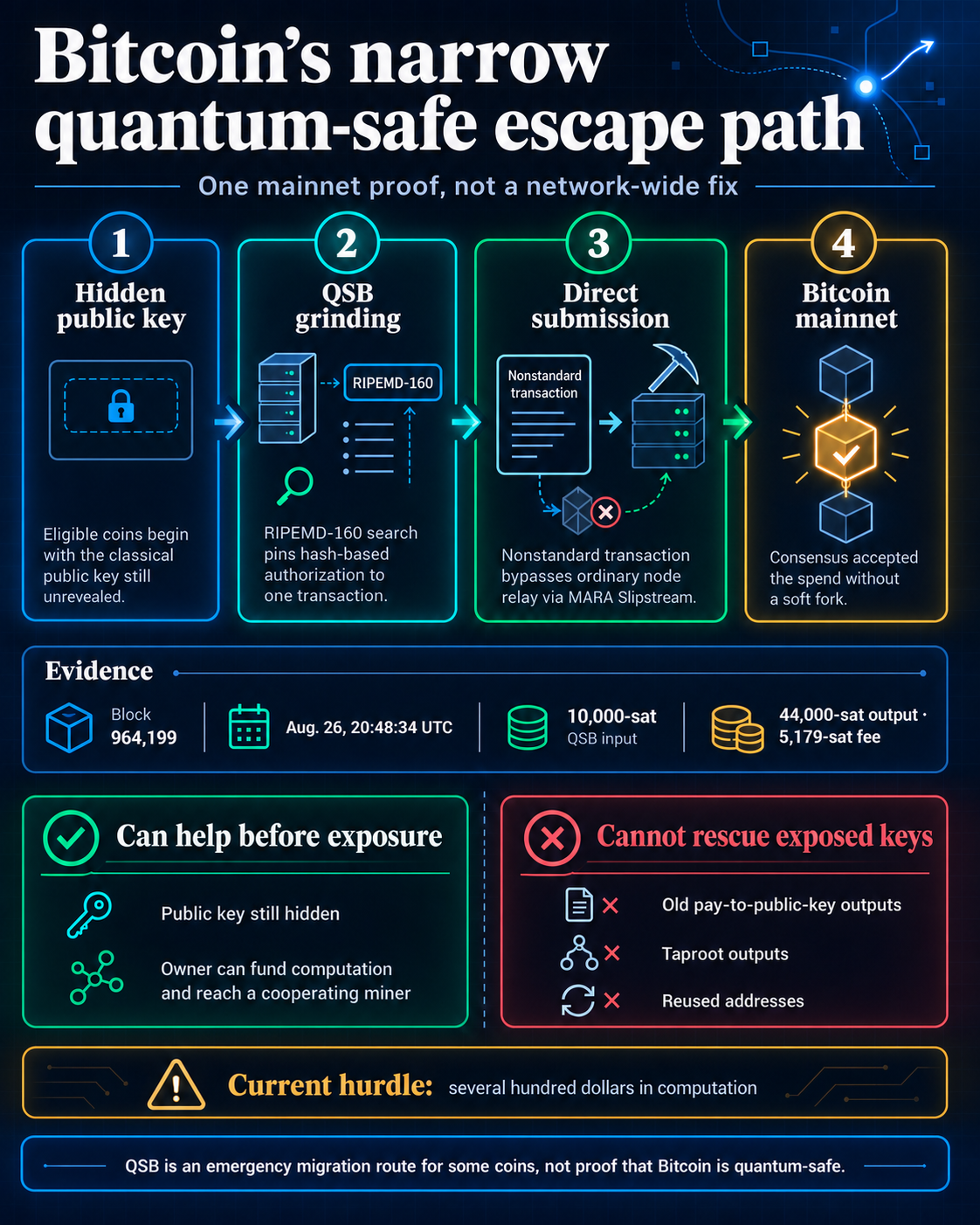
The Aug. 26 transaction used a construction developed by StarkWare researcher Avihu Levy that shifts the critical spending condition away from elliptic-curve signatures and toward hash-based security. It was included in block 964,199 after being submitted directly to Bitcoin miner MARA through its Slipstream service.

StarkWare described the transaction as the first quantum-safe spend on Bitcoin mainnet. Earlier experiments explored post-quantum approaches in Bitcoin Script and on Blockstream’s Liquid sidechain, but this test showed that Bitcoin itself could accept a hash-based spending path without changing consensus rules.

However, the workaround does not make Bitcoin quantum-safe.

StarkWare Chief Executive Eli Ben-Sasson said the test should not be interpreted as evidence that Bitcoin is already prepared for quantum computing. He argued that broader soft-fork solutions are still needed to protect the network at scale.

“A quantum-safe Bitcoin tx on mainnet” proves that workable approaches exist, Ben-Sasson said, while warning that the main task remains building a migration path before quantum hardware becomes capable of threatening exposed keys.

How Quantum-Safe Bitcoin operates

For many Bitcoin addresses, the public key stays concealed behind a hash until the holder spends from that address. That delay matters because a future quantum attacker would need the public key before attempting to derive the corresponding private key.

Levy’s Quantum-Safe Bitcoin, or QSB, construction uses that window to move eligible coins into a hash-based spending condition before the classical public key is revealed.
Bitcoin now has a quantum computing escape route, but 7 million BTC may still be exposedBitcoin now has a quantum computing escape route, but 7 million BTC may still be exposed

The method works by repeatedly varying candidate transaction data until it produces a hash that Bitcoin accepts as a validly formatted signature. That computation takes place before the transaction is broadcast, shifting the security assumption away from elliptic-curve cryptography and toward the difficulty of reversing hash functions.

The Daily Brief

The signal, before the noise.

Start your day with the crypto stories moving markets, decoded by CryptoSlate’s editors.

One email. Everything that matters.

Free to join. Unsubscribe any time.

Whoops, looks like there was a problem. Please try again.

You’re on the list. Your next Daily Brief is on its way.

Quantum computers can also accelerate attacks on hashes, but the advantage is far smaller than the one Shor’s algorithm provides against public-key cryptography. That gives QSB a potential migration path for coins whose public keys remain hidden.

Related Reading

Latest “quantum computer breaks the math behind Bitcoin” headlines massively exaggerate risk

The protection does not extend to coins whose public keys are already visible. Older pay-to-public-key outputs, Taproot outputs, and reused addresses remain exposed because a future quantum attacker could target those keys before the owner completed a migration.

QSB also remains impractical for routine wallet use.

Although the transaction is valid under Bitcoin’s consensus rules, it is nonstandard under default node policy and therefore will not normally propagate through the public mempool. StarkWare had to submit the transaction directly to MARA through Slipstream, its service for handling certain nonstandard transactions.

The required computation adds another barrier. StarkWare said the mainnet test cost several hundred dollars, while the project’s open-source repository estimates roughly $75 to $150 for some configured cloud-GPU search phases.

Those constraints leave QSB as a specialized escape route for some holders rather than a scalable answer to Bitcoin’s broader quantum risk.

Bitcoin’s larger quantum problem remains unresolved

The demonstration arrives as quantum risk moves further into institutional planning.

Roughly 7 million BTC are considered potentially vulnerable because their public keys are already visible through older address formats, Taproot usage, or address reuse. QSB does not provide a rescue path for those coins.

In July, BlackRock, Coinbase, Strategy, and six other institutions formed the Bitcoin Security Consortium and pledged a combined $15 million over three years toward Bitcoin security research, including post-quantum cryptography. Members direct the funding independently rather than through a common pool.

The US Treasury has also brought digital assets into the financial sector’s broader quantum-readiness planning.

That leaves Bitcoin with two separate challenges: developing migration tools for holders whose keys remain hidden and finding a protocol-level answer for coins already exposed.

The Aug. 26 transaction shows that the first problem has at least one working mainnet solution. The second, which covers millions of Bitcoin, still requires a broader answer.

Share76Tweet47

Related Posts

Bitcoin mining faces a squeeze: the $82,900 price hurdle

by Coininsight
September 16, 2026
0

Bitcoin’s August price recovery coincided with a sharp improvement in mining revenue, but the network is preparing to reclaim part...

$1.5B In Iranian Oil Proceeds Were Laundered On Binance: US Feds

by Coininsight
September 15, 2026
0

The U.S. Department of Justice said Monday it is seizing and seeking to forfeit $61 million in cryptocurrency that it...

August 2026 Work Progress: Ravencoin Chain Rescue, Pearl Hard Fork, and Kaspa Reward Cut

by Coininsight
September 14, 2026
0

Ravencoin (RVN) Consensus Exploit and Chain Recovery This was the most serious incident on any of our pools this year,...

Canaan revenue misses guidance; 1,117 BTC pledged in Q2

by Coininsight
September 13, 2026
0

Canaan, the Bitcoin mining-equipment maker, reported second-quarter 2026 revenue below its earlier guidance on Sept. 8, as weaker machine demand...

Bitcoin’s ‘Unusual Mix’: Report

by Coininsight
September 12, 2026
0

Bitcoin’s path higher just got harder in the short term, but the setup further out may be improving, according to...

Load More
  • Trending
  • Comments
  • Latest
What’s Actually Going On With Ripple’s Blockchain?

What’s Actually Going On With Ripple’s Blockchain?

January 12, 2026
MetaMask Launches An NFT Reward Program – Right here’s Extra Data..

MetaMask Launches An NFT Reward Program – Right here’s Extra Data..

July 24, 2025
Finest Bitaxe Gamma 601 Overclock Settings & Tuning Information

Finest Bitaxe Gamma 601 Overclock Settings & Tuning Information

November 26, 2025
Easy methods to Host a Storj Node – Setup, Earnings & Experiences

Easy methods to Host a Storj Node – Setup, Earnings & Experiences

March 11, 2025
Kuwait bans Bitcoin mining over power issues and authorized violations

Kuwait bans Bitcoin mining over power issues and authorized violations

2
The Ethereum Basis’s Imaginative and prescient | Ethereum Basis Weblog

The Ethereum Basis’s Imaginative and prescient | Ethereum Basis Weblog

2
Unchained Launches Multi-Million Greenback Bitcoin Legacy Mission

Unchained Launches Multi-Million Greenback Bitcoin Legacy Mission

1
Earnings Preview: Microsoft anticipated to report larger Q3 income, revenue

Earnings Preview: Microsoft anticipated to report larger Q3 income, revenue

1

The Burden of Proof(s): Code Merkleization

September 17, 2026

What’s new in Astute, September 2026 update (v3.6)

September 17, 2026

Forget Lloyds shares! This FTSE bank is up 60% in the past year

September 17, 2026

Ripple CEO Sees Reason for Crypto Optimism After CLARITY Act Defeat

September 16, 2026

CoinInight

Welcome to CoinInsight.co.uk – your trusted source for all things cryptocurrency! We are passionate about educating and informing our audience on the rapidly evolving world of digital assets, blockchain technology, and the future of finance.

Categories

  • Bitcoin
  • Blockchain
  • Crypto Mining
  • Ethereum
  • Future of Crypto
  • Market
  • Regulation
  • Ripple

Recent News

The Burden of Proof(s): Code Merkleization

September 17, 2026

What’s new in Astute, September 2026 update (v3.6)

September 17, 2026
  • About
  • Privacy Poilicy
  • Disclaimer
  • Contact

© 2025- https://coininsight.co.uk/ - All Rights Reserved

No Result
View All Result
  • Home
  • Bitcoin
  • Ethereum
  • Regulation
  • Market
  • Blockchain
  • Ripple
  • Future of Crypto
  • Crypto Mining

© 2025- https://coininsight.co.uk/ - All Rights Reserved

Social Media Auto Publish Powered By : XYZScripts.com
Verified by MonsterInsights