Ethereum supply has grown at almost exactly Bitcoin’s pace since mid-2025, and Bitmine chairman Tom Lee used that fact on Monday to pitch ether as “hard money.”
The claim arrived in Bitmine Immersion Technologies’ weekly holdings update, filed with the SEC on Nov. 23.
Bitmine said it bought another 7,819 ETH in the past week, lifting its stash to 6,085,564 ETH, or 4.98% of all ether in existence.
We checked Lee’s supply math against public on-chain data. It largely holds up.
The bigger question is how long the match can last, because Bitcoin’s issuance has a fixed schedule and its next cut is already in sight.
What Tom Lee Said About Ether and Bitcoin
Lee measured supply from June 30, 2025, the day Bitmine switched to its ether treasury strategy.
By his count, ETH supply rose 1.26% in total since then, or 0.90% a year. He put Bitcoin’s annualized supply growth at 0.82% over the same stretch.
“In other words, ETH and BTC have essentially the same inflation rate and both are ‘hard money’ measured in supply growth,” Lee said in the release.
He contrasted that with Solana at 7.6%, XRP at 5.4% and Cardano at 2.9% a year, calling those tokens “far more inflationary.”

ADVERTISEMENT
That is a striking compliment to Bitcoin. Lee’s benchmark for sound money in crypto is the asset he does not mainly hold.
Does the Ethereum Supply Data Back the Claim?
Mostly, yes. Our own figures came out slightly kinder to ether than Lee’s.
Ultrasound.money’s daily series shows ETH supply at 120.87 million on June 30, 2025, and 122.24 million on Nov. 22, 2026. That is a 1.14% rise, or about 0.81% a year.
For Bitcoin, we took block heights from mempool.space and applied the protocol’s 3.125 BTC block subsidy. Supply went from about 19.886 million BTC at block 903,453 to about 20.116 million at block 977,125.
That works out to 1.16% in total, or roughly 0.83% a year, which is close to Lee’s 0.82%.
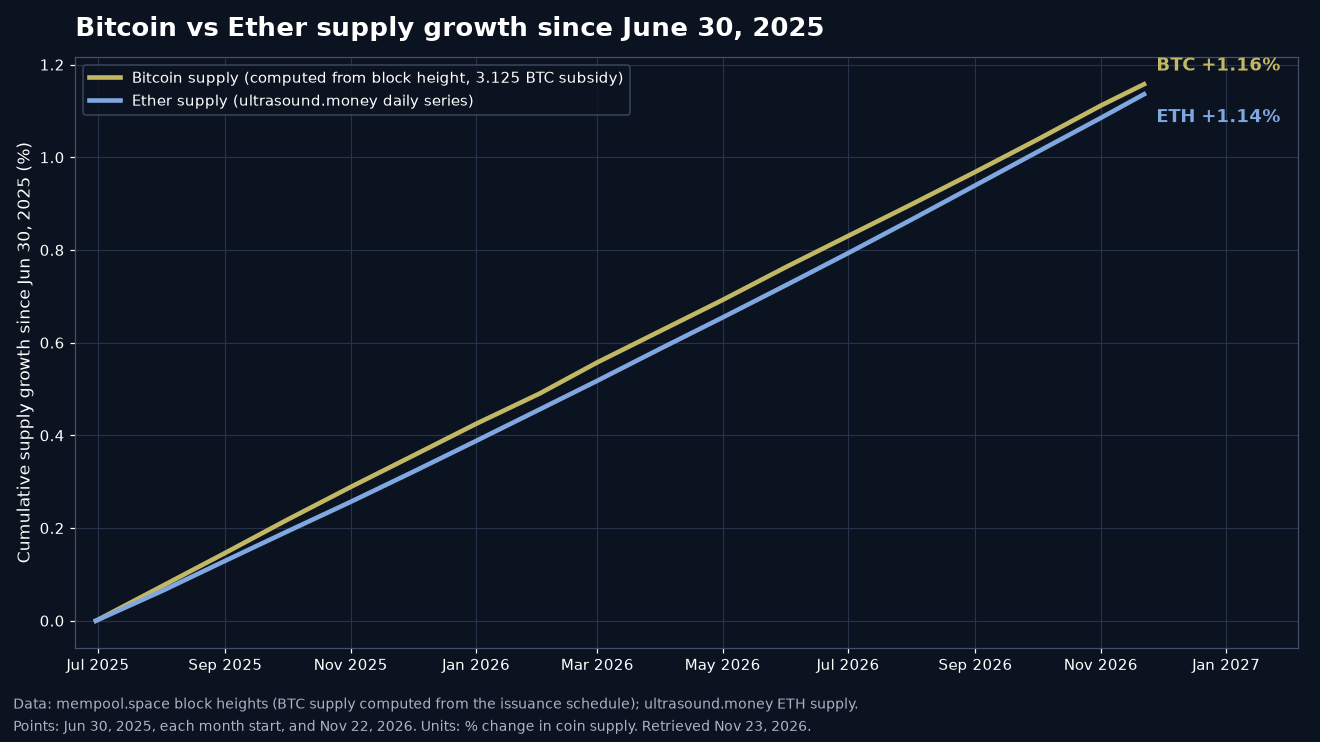
The lines almost overlap. Over the past 30 days, though, ether’s supply grew at an annualized 0.87%, a touch faster than Bitcoin’s steady pace of about 0.82%.
That gap is small, but it shows the key difference. Ether’s net issuance moves with staking and with how much fee revenue gets burned. Bitcoin’s moves with nothing but the block clock.
Why the 2028 Halving Changes the ETH Supply Comparison
Bitcoin’s next halving is scheduled for block 1,050,000. That is roughly 72,900 blocks from where the chain stood on Nov. 22.
At an average of 144 blocks a day, that points to around April 2028, although the exact date depends on hash rate.
When it hits, the block subsidy drops to 1.5625 BTC. New issuance falls to roughly 82,000 BTC a year, or about 0.4% of supply.
In other words, today’s near-tie is a snapshot. Bitcoin’s issuance rate is already set to halve, and the 21 million cap never moves.
Ether has no fixed cap. Its supply actually shrank after the Merge, bottoming near 120.06 million in April 2024, before rising again as fee burns faded. Since the Merge in September 2022, ETH supply is up about 1.4%.
We believe that is the honest reading of Lee’s comparison. Ether has behaved like a low-inflation asset lately, while Bitcoin’s scarcity is written into its code in advance.
Bitmine ETH Holdings Grow, but the Buying Pace Keeps Easing
Bitmine said it has bought ETH every week since June 30, 2025, and this week was no exception.
The size of those purchases has come down sharply, though. Its weekly filings show a peak of 53,501 ETH in the week to Aug. 30. Purchases have been between about 7,600 and 9,600 ETH for each of the last four weeks.
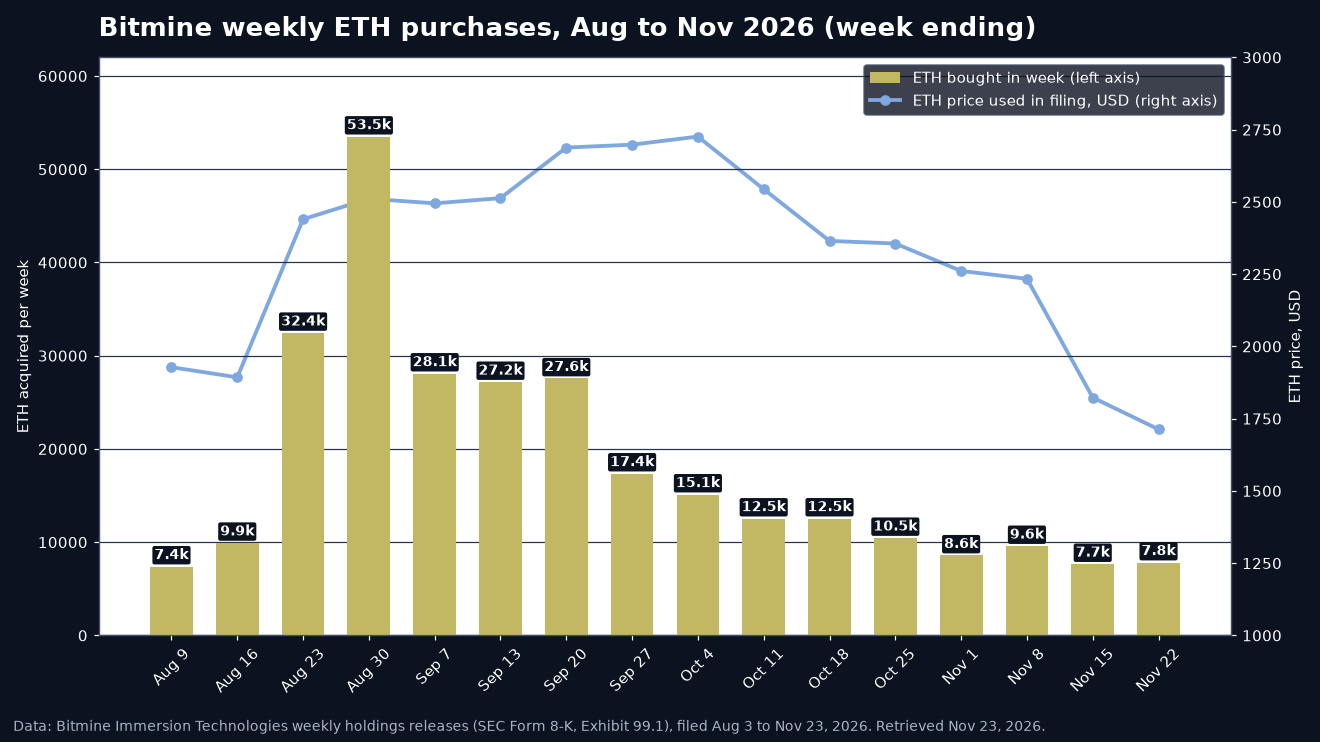
Prices have moved the other way. Bitmine valued ether at $2,726 in its Oct. 4 update and at $1,713 in Monday’s update, about 37% lower.
As we noted when Lee tied ether’s slide to Anthropic’s IPO, the weekly buys had already shrunk to 7,653 ETH. This week’s 7,819 ETH is a small step back up.
The company reported 5,227,037 staked ETH, roughly 86% of its holdings, plus 216 BTC and $384 million in cash and marketable securities. It put its total crypto, cash and “moonshot” holdings at $11.1 billion.
What Bitcoin Investors Can Take From the Comparison
When the biggest ether treasury reaches for a benchmark of monetary discipline, it picks Bitcoin. We think that says a lot about where the market’s standard for sound money sits.
It also mirrors the corporate treasury race. Bitmine ranks itself second globally behind Strategy, which holds far more value in BTC alone. As we covered when Strategy detailed its net reserve, none of its bitcoin is pledged.
For Bitcoin holders, the supply data is a reminder, not a threat. Bitcoin’s supply growth is already under 1% a year, and it is scheduled to roughly halve within about 17 months.
With BTC trading near $61,300 on Monday, according to CoinGecko data, we believe that fixed schedule is still the strongest long-term argument in crypto.
The next few weekly Bitmine filings will show whether ether’s buyers return in size. Bitcoin’s issuance path, meanwhile, needs no filing at all.
DC Forecasts is a leader in many crypto news categories, striving for the highest journalistic standards and abiding by a strict set of editorial policies. If you are interested to offer your expertise or contribute to our news website, feel free to contact us at [email protected]
Ethereum supply has grown at almost exactly Bitcoin’s pace since mid-2025, and Bitmine chairman Tom Lee used that fact on Monday to pitch ether as “hard money.”
The claim arrived in Bitmine Immersion Technologies’ weekly holdings update, filed with the SEC on Nov. 23.
Bitmine said it bought another 7,819 ETH in the past week, lifting its stash to 6,085,564 ETH, or 4.98% of all ether in existence.
We checked Lee’s supply math against public on-chain data. It largely holds up.
The bigger question is how long the match can last, because Bitcoin’s issuance has a fixed schedule and its next cut is already in sight.
What Tom Lee Said About Ether and Bitcoin
Lee measured supply from June 30, 2025, the day Bitmine switched to its ether treasury strategy.
By his count, ETH supply rose 1.26% in total since then, or 0.90% a year. He put Bitcoin’s annualized supply growth at 0.82% over the same stretch.
“In other words, ETH and BTC have essentially the same inflation rate and both are ‘hard money’ measured in supply growth,” Lee said in the release.
He contrasted that with Solana at 7.6%, XRP at 5.4% and Cardano at 2.9% a year, calling those tokens “far more inflationary.”
ADVERTISEMENT
That is a striking compliment to Bitcoin. Lee’s benchmark for sound money in crypto is the asset he does not mainly hold.
Does the Ethereum Supply Data Back the Claim?
Mostly, yes. Our own figures came out slightly kinder to ether than Lee’s.
Ultrasound.money’s daily series shows ETH supply at 120.87 million on June 30, 2025, and 122.24 million on Nov. 22, 2026. That is a 1.14% rise, or about 0.81% a year.
For Bitcoin, we took block heights from mempool.space and applied the protocol’s 3.125 BTC block subsidy. Supply went from about 19.886 million BTC at block 903,453 to about 20.116 million at block 977,125.
That works out to 1.16% in total, or roughly 0.83% a year, which is close to Lee’s 0.82%.
The lines almost overlap. Over the past 30 days, though, ether’s supply grew at an annualized 0.87%, a touch faster than Bitcoin’s steady pace of about 0.82%.
That gap is small, but it shows the key difference. Ether’s net issuance moves with staking and with how much fee revenue gets burned. Bitcoin’s moves with nothing but the block clock.
Why the 2028 Halving Changes the ETH Supply Comparison
Bitcoin’s next halving is scheduled for block 1,050,000. That is roughly 72,900 blocks from where the chain stood on Nov. 22.
At an average of 144 blocks a day, that points to around April 2028, although the exact date depends on hash rate.
When it hits, the block subsidy drops to 1.5625 BTC. New issuance falls to roughly 82,000 BTC a year, or about 0.4% of supply.
In other words, today’s near-tie is a snapshot. Bitcoin’s issuance rate is already set to halve, and the 21 million cap never moves.
Ether has no fixed cap. Its supply actually shrank after the Merge, bottoming near 120.06 million in April 2024, before rising again as fee burns faded. Since the Merge in September 2022, ETH supply is up about 1.4%.
We believe that is the honest reading of Lee’s comparison. Ether has behaved like a low-inflation asset lately, while Bitcoin’s scarcity is written into its code in advance.
Bitmine ETH Holdings Grow, but the Buying Pace Keeps Easing
Bitmine said it has bought ETH every week since June 30, 2025, and this week was no exception.
The size of those purchases has come down sharply, though. Its weekly filings show a peak of 53,501 ETH in the week to Aug. 30. Purchases have been between about 7,600 and 9,600 ETH for each of the last four weeks.
Prices have moved the other way. Bitmine valued ether at $2,726 in its Oct. 4 update and at $1,713 in Monday’s update, about 37% lower.
As we noted when Lee tied ether’s slide to Anthropic’s IPO, the weekly buys had already shrunk to 7,653 ETH. This week’s 7,819 ETH is a small step back up.
The company reported 5,227,037 staked ETH, roughly 86% of its holdings, plus 216 BTC and $384 million in cash and marketable securities. It put its total crypto, cash and “moonshot” holdings at $11.1 billion.
What Bitcoin Investors Can Take From the Comparison
When the biggest ether treasury reaches for a benchmark of monetary discipline, it picks Bitcoin. We think that says a lot about where the market’s standard for sound money sits.
It also mirrors the corporate treasury race. Bitmine ranks itself second globally behind Strategy, which holds far more value in BTC alone. As we covered when Strategy detailed its net reserve, none of its bitcoin is pledged.
For Bitcoin holders, the supply data is a reminder, not a threat. Bitcoin’s supply growth is already under 1% a year, and it is scheduled to roughly halve within about 17 months.
With BTC trading near $61,300 on Monday, according to CoinGecko data, we believe that fixed schedule is still the strongest long-term argument in crypto.
The next few weekly Bitmine filings will show whether ether’s buyers return in size. Bitcoin’s issuance path, meanwhile, needs no filing at all.
DC Forecasts is a leader in many crypto news categories, striving for the highest journalistic standards and abiding by a strict set of editorial policies. If you are interested to offer your expertise or contribute to our news website, feel free to contact us at [email protected]