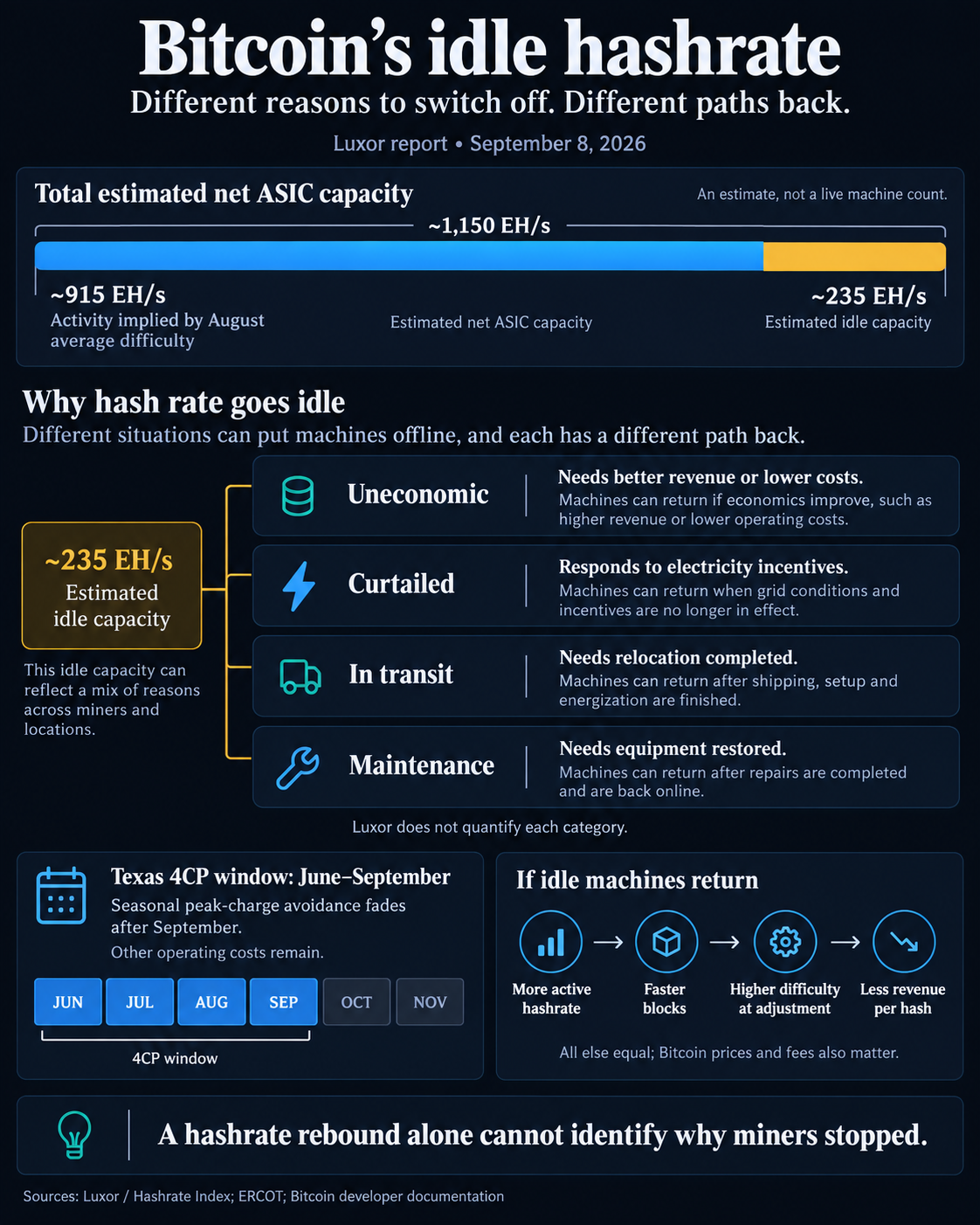
Mining services firm Luxor estimates that about 235 exahashes per second (EH/s) of capacity in specialized Bitcoin mining machines is sitting idle.
Its Sept. 8 report puts that equipment in several categories: machines that are uneconomic, deliberately curtailed, in transit, or under maintenance. Their different reasons for switching off make a rebound in hashrate an ambiguous signal of recovery from financial distress.
August’s Bitcoin rally improved the revenue available from mining, while Texas’s summer window for avoiding peak-related transmission charges runs through September.
Either route can eventually add competition for the miners that stayed online. The revenue recovery that encourages a restart may become smaller once enough other operators make the same decision.
According to Luxor’s August lookback, dollar-denominated hashprice rose 24.4% during the month, from $31.63 to $39.33 per petahash per second per day. Hashprice measures expected mining revenue for a given amount of computing power, before electricity and other expenses.
Bitcoin’s price rose 24.5% over the same period, from $62,889 to $78,312 in Luxor’s data. A more valuable Bitcoin increases the dollar value of the rewards miners compete to earn.
The improvement mattered for less efficient equipment, although the month still looked difficult overall. Luxor’s fleet tier consuming 25 to 38 joules per terahash generated about $45 per megawatt-hour on average in August, below its estimated network-average electricity cost of $48. That tier exceeded the benchmark on 11 days.
Profitability depends on each operator’s power contract, financing, staffing, and other costs. The late-month revenue improvement helps explain why some machines that struggled earlier in the month could have become more attractive to operate as revenue improved.
Luxor reports that blocks averaged 9 minutes and 34 seconds in August, faster than Bitcoin’s roughly 10-minute target. The Sept. 5 difficulty adjustment subsequently increased 1.31%.
| Metric | July / start point | August / end point | Change | Why it matters |
|---|---|---|---|---|
| USD hash price | $31.63 per PH/s/day | $39.33 per PH/s/day | +24.4% | Higher mining revenue can bring marginal ASICs back online. |
| Bitcoin price | $62,889 | $78,312 | +24.5% | BTC price drove most of the revenue recovery. |
| 25–38 J/TH fleet revenue | — | ~$45/MWh avg. | Still below $48/MWh benchmark power cost | Less efficient fleets improved, but did not fully clear average cost. |
| Days above benchmark | — | 11 days | Partial recovery | Restart incentives may be episodic, not permanent. |
| Sept. 5 difficulty move | — | +1.31% | Margin headwind | The network had already begun absorbing the rebound. |
What the missing 235 EH/s actually measures
Luxor’s estimate compares roughly 1,150 EH/s of total net ASIC capacity with about 915 EH/s of activity implied by August’s average mining difficulty. The resulting 235 EH/s gap indicates the scale of sidelined capacity, using an equipment estimate and an activity measure derived from difficulty.
An uneconomic machine needs better revenue, lower costs, or both, while a machine being transported or maintained needs to become operational again. Deliberately curtailed equipment may already be usable but temporarily worth more to its owner when switched off.
The amount that could restart at a given hash price remains uncertain because Luxor leaves the individual categories unquantified.
Financial pressure can force equipment offline, but the same network-level decline can result from an operator responding rationally to electricity-market incentives. Both decisions can produce a similar decline in estimated computing activity.
Blockchain.com explains that Bitcoin’s exact hashing power is unknown and must be estimated from difficulty and the rate at which blocks are found. Daily readings can fluctuate because block discovery is random, even when underlying computing power stays constant. A seven-day average is more representative.
Smoothing cannot separate a distressed miner from one avoiding an expensive period of electricity use.
Texas grid operator ERCOT’s four coincident peaks, usually shortened to 4CP, cover June, July, August and September. The grid operator defines each peak as the highest-load 15-minute settlement interval in that month.
Luxor says Texas miners reduce activity during summer to avoid the associated transmission charges. For operators exposed to that incentive, running a machine can cost more than the electricity consumed at that moment.
The ending of the seasonal window in September removes this particular reason for peak avoidance until the next summer, creating an opportunity for some curtailed capacity to return. Electricity-price risk and the revenue needed to cover operating costs still determine whether a marginal machine can run.
September’s peak remains provisional while the month unfolds because a later interval could set a higher load. The end of the window provides a clear seasonal boundary, while individual restart decisions will depend on each operation’s economics.
CryptoSlate’s Sept. 2 analysis examined how AI and high-performance computing commitments can weaken mining’s response to better Bitcoin economics. That remains a separate constraint on recovery, with the AI-related share of Luxor’s idle-capacity estimate unspecified.
| Idle-capacity bucket | What it means | Likely restart trigger | Speed of return | Signal value for miner stress |
|---|---|---|---|---|
| Uneconomic ASICs | Machines switched off because revenue does not cover cost | Higher BTC price, higher fees, lower power cost, or lower difficulty | Slow to medium | Strong stress signal |
| Curtailed capacity | Machines intentionally powered down for grid or power-market economics | End of 4CP season, lower power prices, grid-stability incentives | Fast | Weak stress signal |
| In-transit machines | Hardware moving between sites or buyers | Delivery, installation, hosting availability | Medium | Neutral |
| Maintenance downtime | Machines offline for repair or optimization | Repair completion, firmware/hardware work | Medium | Neutral to mild stress |
| AI/HPC reallocation | Power or infrastructure redirected away from BTC mining | BTC mining outbids alternative compute economics | Slow | Structural constraint |
A restart can reduce the reward for restarting
Bitcoin’s adjustment mechanism connects returning machines to the next potential margin squeeze.
The protocol retargets difficulty every 2,016 blocks, aiming for roughly two weeks of production. If additional computing power makes blocks arrive faster over an adjustment period, difficulty can rise.
At greater difficulty, the same machine earns less expected Bitcoin revenue per unit of computing power, with block rewards and fees held constant.
The effect takes time to pass through the adjustment process, and the dollar effect also depends on Bitcoin’s price and transaction fees.
Luxor noted that October difficulty rose in each year from 2022 through 2025, averaging roughly 10% across the month. Its separate 4.38% figure is the average per adjustment.
| Scenario | What happens | Difficulty path | Hashprice impact | Article takeaway |
|---|---|---|---|---|
| Base case | Some curtailed Texas capacity returns after September; uneconomic machines stay selective | Moderate increase | Hashprice gives back part of August rally | Recovery is real but self-limiting. |
| Bull case | BTC price keeps rising faster than difficulty | Difficulty rises, but lags revenue | Hashprice holds near improved levels | Miners regain operating leverage. |
| Bear case | Large idle capacity restarts while BTC stalls | Difficulty rises sharply | Hashprice compresses | The rebound becomes a margin trap. |
| Black swan | Power-price spike, BTC pullback, or forced selling hits weaker miners | Difficulty volatility rises after shutdowns | Hashprice whipsaws | Hashrate becomes a poor real-time signal of financial health. |
The next useful evidence will be a sustained change in smoothed hashrate, subsequent difficulty adjustments, and operator disclosures about curtailment and restarts. Together, those could help show how much capacity had been temporarily waiting.
Distinguishing persistent financial stress from infrastructure reassignment would still require evidence from the operators themselves.
For miners, the immediate question is how much of August’s revenue improvement survives the return of their competitors. Machines coming back online can signal better operating conditions while also making those conditions less profitable again.