Bitcoin’s post-retarget relief for miners was real, but narrow.
Using a BTC price of $84,751, the completed difficulty increase and the latest gross hashprice is about $40.31 per petahash per second per day. That is roughly 2.65% above the prior modeled baseline.
However, the next difficulty estimate is pointing 2.48% lower. The estimate came after only 14.43% of the new epoch, making it an early signal from slower blocks rather than a result or proof that miners were switching off.
The two readings are compatible. Price had restored a modest amount of gross revenue per unit of computing power after the Sept. 19 retarget. The early block pace showed that the network’s next adjustment remained unsettled.
Bitcoin mining economics improved versus the prior model
A Sept. 15 CryptoSlate analysis calculated that BTC would need to reach about $82,877 to neutralize the revenue-per-hash impact of the difficulty increase then forecast for Sept. 19. That was a modeled network threshold, not an industry-wide production cost.
The realized adjustment was less severe than projected. Mempool’s completed difficulty history shows difficulty rose 4.1634% at block 967,680 on Sept. 19, from 127.451 trillion to 132.757 trillion. At press time, CryptoSlate’s Bitcoin market page showed $84,751, which was about 2.26% above the prior model threshold.
Relative to the Sept. 15 model inputs, BTC’s price had risen about 7.07% while realized difficulty increased 4.16%. The price-to-difficulty ratio improved roughly 2.79%. Including the lower recent fee average, theoretical gross hashprice was about 2.65% above the prior baseline.
| Indicator | Frozen value | Comparison | Interpretation |
|---|---|---|---|
| BTC price | $84,751 | 2.26% above the $82,877 model threshold | Price cleared the prior revenue-per-hash hurdle |
| Mining difficulty | 132.757 trillion | Up 4.16% on Sept. 19 | Competition for each unit of reward increased |
| Theoretical gross hashprice | About $40.31 per PH/s per day | About 2.65% above the prior model baseline | Gross network revenue per unit of hash improved modestly |
| Fees in the 144-block sample | 0.01422626 BTC per block | 0.45% of total rewards | Fees added little support in this window |
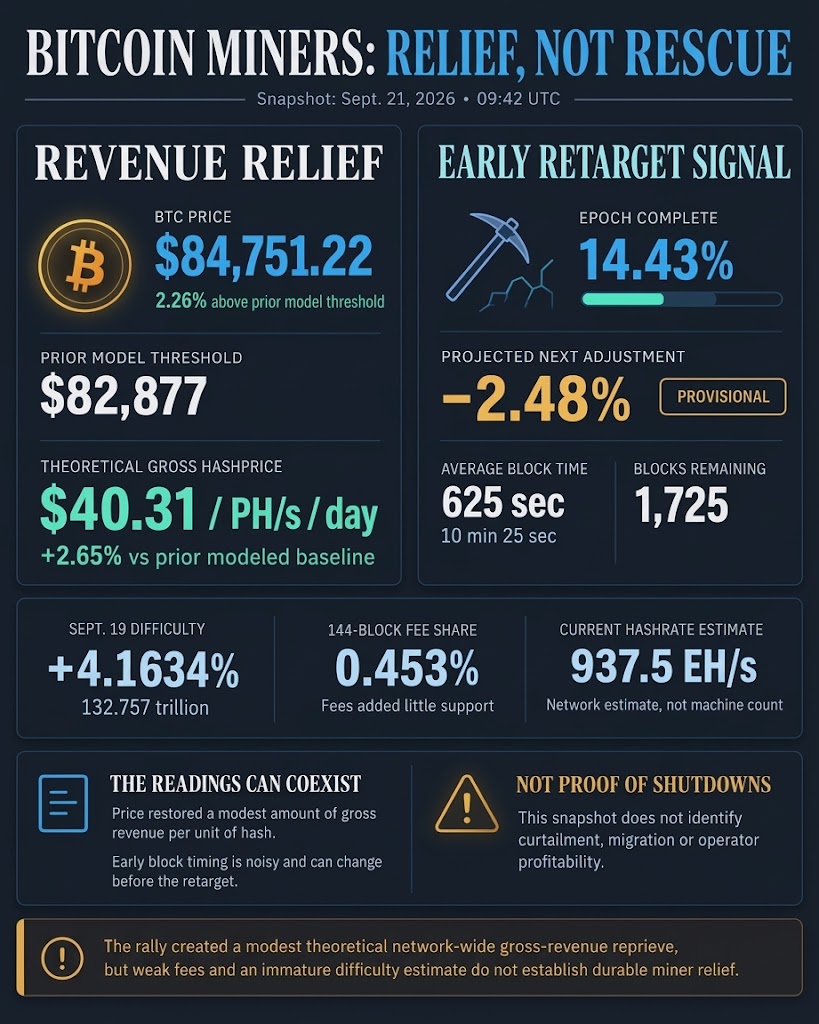
The hashprice estimate uses the 3.125 BTC subsidy, the observed average fee, the frozen BTC price and the network difficulty. It is a theoretical gross revenue benchmark, not reported realized revenue or profit.
Fees offered little extra protection in the measured window. Mempool’s reward statistics show that blocks 967,828 through 967,971 generated 2.04858206 BTC in fees, averaging 0.01422626 BTC per block. Fees were about 0.45% of the 452 BTC total reward across those 144 blocks.
That figure should not be extended into a durable fee regime. It says only that miner revenue in this sample remained overwhelmingly dependent on the block subsidy and BTC price.
Network hashprice also cannot determine which operators were profitable. Fleet efficiency, power contracts, financing, staffing and other costs differ across businesses. As prior CryptoSlate mining analysis documented, the same network revenue level can affect operators differently because their cost structures differ.
The projected difficulty decline is an early signal, not a result
The frozen Mempool difficulty snapshot placed the new epoch at 14.43% complete. Blocks had averaged 625.3 seconds, or about 10 minutes and 25 seconds, with 1,725 blocks remaining. On that pace, the estimate pointed to a 2.48% difficulty reduction around Oct. 3.
Bitcoin recalibrates difficulty every 2,016 blocks to bring average production back toward one block every 10 minutes, as the Bitcoin developer guide explains. Slower-than-target blocks therefore push the next estimate lower.
But a difficulty projection is not a direct count of active machines. Block discovery is stochastic, so short samples can change sharply even if underlying computing power has not made an equally sharp move. Hashrate Index research found that constant-block-time forecasts are especially inaccurate near the beginning of an epoch.
Technical work by Pieter Wuille and academic research on Bitcoin block arrivals support the broader point that early block timing is a noisy hashrate signal. The evidence does not justify treating the Mempool estimate as a diagnosis of shutdowns, curtailment or equipment migration.
Mempool’s one-month estimated hashrate series ranged from roughly 826.1 EH/s to 1.053 ZH/s, while its current estimate was about 937.5 EH/s. Within that observation window, the series showed no sustained, obvious cliff.
Those figures are estimates inferred from block production, not direct readings from every mining machine. They cannot rule out changes at individual operators, and the current estimate should not be confused with the latest daily observation. They show only that the available network series did not display the kind of persistent collapse that would make a broad shutdown claim defensible.
The early retarget reading still matters. If slower blocks persist as the sample grows, the projected decline becomes more informative and a lower completed difficulty would reduce the amount of work competing for each block reward. If blocks accelerate, the estimate can shrink or reverse before the retarget.
What would make the improvement durable
The next test has three parts: BTC price, transaction fees and the maturing block sample.
Price remaining above the prior modeled hurdle would preserve the relief created by the rally. A larger fee contribution would add a second source of revenue instead of leaving miners almost entirely dependent on subsidy and price. A downward retarget that survives a much larger share of the epoch would provide stronger evidence that effective network hashrate had softened.
Even then, network data would not identify the operational cause. Previous CryptoSlate reporting has tracked large AI infrastructure commitments across public miners, but that sector shift does not explain this snapshot’s slower blocks without operator-level evidence.
For now, the strongest conclusion is narrower. Bitcoin’s rally more than offset the finalized difficulty increase in a theoretical network-wide calculation, producing a modest gross-revenue reprieve. Weak fees and an immature next-retarget estimate leave the durability of that relief unresolved.