Ethereum co-founder Vitalik Buterin says laptop AI is approaching a practical turning point. Wallet software still needs a much higher bar before it can hand an AI control over crypto assets.
He said on Sept. 17 that Qwen 3.8 Flash and recent improvements in llama.cpp had brought local models close to handling a “large share” of tasks on his Strix Halo laptop.
For more advanced work, he described a local model coordinating requests to stronger remote systems while withholding the user’s full personal context.
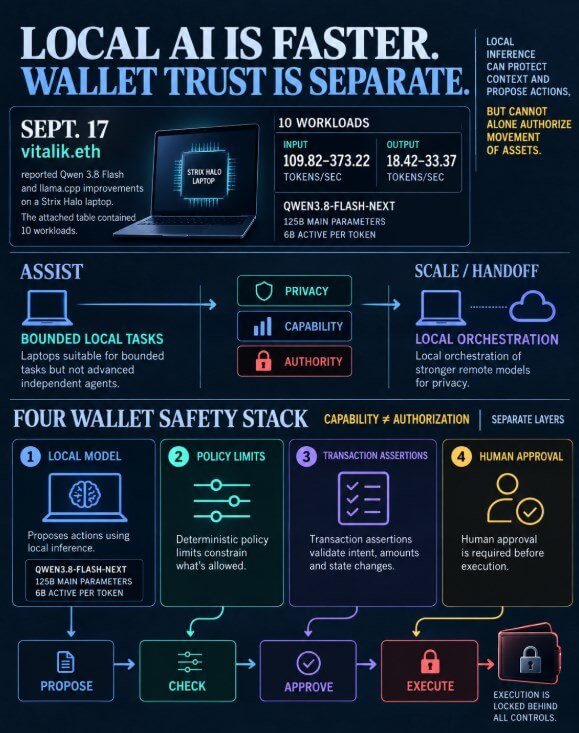
The benchmark image attached to the post showed 10 workloads. Its reported input-processing rates ranged from 109.82 to 373.22 tokens per second, while output generation ranged from 18.42 to 33.37 tokens per second.
Those figures support a practical claim about responsiveness on one high-end laptop. They leave model judgment, resistance to malicious instructions, and transaction authorization unanswered.
Local inference can improve privacy while the power to move funds remains behind separate, enforceable controls.
Ethereum co-founder shows what changed between April and September
In an April account of his local AI setup, Vitalik described a narrower role for laptop models.
He wrote that Qwen3.5:35B could handle bounded tasks and familiar programming work, while advanced independent agents that could keep working on a codebase remained beyond laptops’ practical reach. Harder coding and intellectual work still called for stronger remote models.
The September post changes his assessment of where the practical boundary sits. A local model no longer appears limited to transcription, summarization, or other tightly bounded work. In the newer description, it can become the main interface for a larger share of activity and decide when a remote model is necessary.
A remote service receives only the question or context the local model selects, rather than every file, message, and wallet detail needed to understand the user’s wider situation. The local system becomes both an information gatekeeper and an assistant.
April and September involved different model generations and different tasks. The September post provides token counts and throughput, but it omits prompt contents, quantization choices, and the full runtime configuration.
Qwen3.8-Flash-Next, released by Alibaba’s Qwen team, is an open-weight multimodal mixture-of-experts model. Its main model has 125 billion parameters, plus another 51 billion in n-gram embedding tables, while 6 billion parameters are activated per token.
The official repository documents local text and vision inference through llama.cpp using quantized GGUF builds.
Activating a fraction of the model for each token lowers the compute burden. The user still needs enough memory for the chosen build and context, and the official materials provide no single hardware minimum that applies across quantization levels and workloads.
Capability benchmarks leave wallet authority unresolved
Qwen’s technical report evaluates the base model across 14 benchmarks covering general knowledge, mathematics, science, reasoning, coding and multilingual understanding.
The Qwen team reported that Flash-Next beat the larger Qwen3.7-Plus base model on eight of those tests while using fewer activated parameters and less training compute.
The report covers model capability, efficiency, and training stability. Prompt-injection resistance, policy enforcement, wallet authorization, and the correctness of autonomous financial actions sit outside that benchmark set.
An assistant can privately explain a transaction, prepare calldata, or suggest a route. A signer can make an irreversible request that transfers assets or grants another contract permission to move them.
Better reasoning reduces some errors, yet a malicious instruction hidden in a website, message, or transaction description can still redirect the model’s plan.
The Ethereum ecosystem is already testing an on-device version of the assistant concept. In its second-quarter allocation update, the Ethereum Foundation listed Steward, a fully local macOS smart-account wallet whose light client and AI assistant are intended to run on-device.
The disclosure establishes funding and project scope, but leaves production deployment, independent audit status, and autonomous transaction authority unestablished.
Vitalik’s April wallet guidance placed that policy outside the language model. He described a human-confirmation firewall for risky actions, deterministic limits on transaction amounts, calldata, and transaction counts, and a human-plus-model 2-of-2 rule.
model may recognize a scam pattern that a distracted person misses, while a person may reject an action after malicious content manipulates the model. Requiring both approvals for risky transactions prevents either participant from quietly becoming the sole trust anchor.
Low-risk automation can remain available within software-defined permissions. Reading balances, preparing unsigned transactions, or operating under tightly capped limits can make an assistant useful without giving it open-ended spending power.
Wallet trust depends on rules the model cannot rewrite
EIP-7906, which remains a draft, proposes post-transaction assertion frames that inspect the final state differences produced by a transaction. An assertion can reject the application outcome when those changes violate a specified condition.
A wallet could use that mechanism to require that a swap changed only approved balances, that a hidden token approval never appeared, or that a protected account’s state stayed untouched. Those checks compare the transaction’s actual effects with explicit rules.
The draft also describes the edges of the protection. An assertion that checks too little can create false confidence. Wallet validation logic must require the intended assertion frame, and the assertion itself must cover every relevant state change for the protected operation.
Local inference and transaction assertions solve different parts of the wallet-agent problem.
The local model protects context and turns natural-language intent into a proposed action, deterministic permissions restrict recipients, contracts, value, and frequency, assertions inspect final state changes. Human confirmation remains the second factor for risky actions.
September’s laptop result makes the first layer more credible. It suggests a private local model can respond quickly enough to coordinate daily work and selectively use remote intelligence. The remaining layers still carry the authority that protects assets.
A crypto wallet can treat the model as a capable interface, planner, and monitor. Trust belongs to controls the model cannot alter and to an approval path that keeps the user meaningfully in charge.