Consensys announced plans on Sept. 9 to operate MetaMask separately from its Ethereum infrastructure business, giving the consumer wallet and the protocol builder distinct management and investment priorities. For holders of ether, the split puts a practical question at the center of the growth story: how much activity will reach the networks that use ETH?
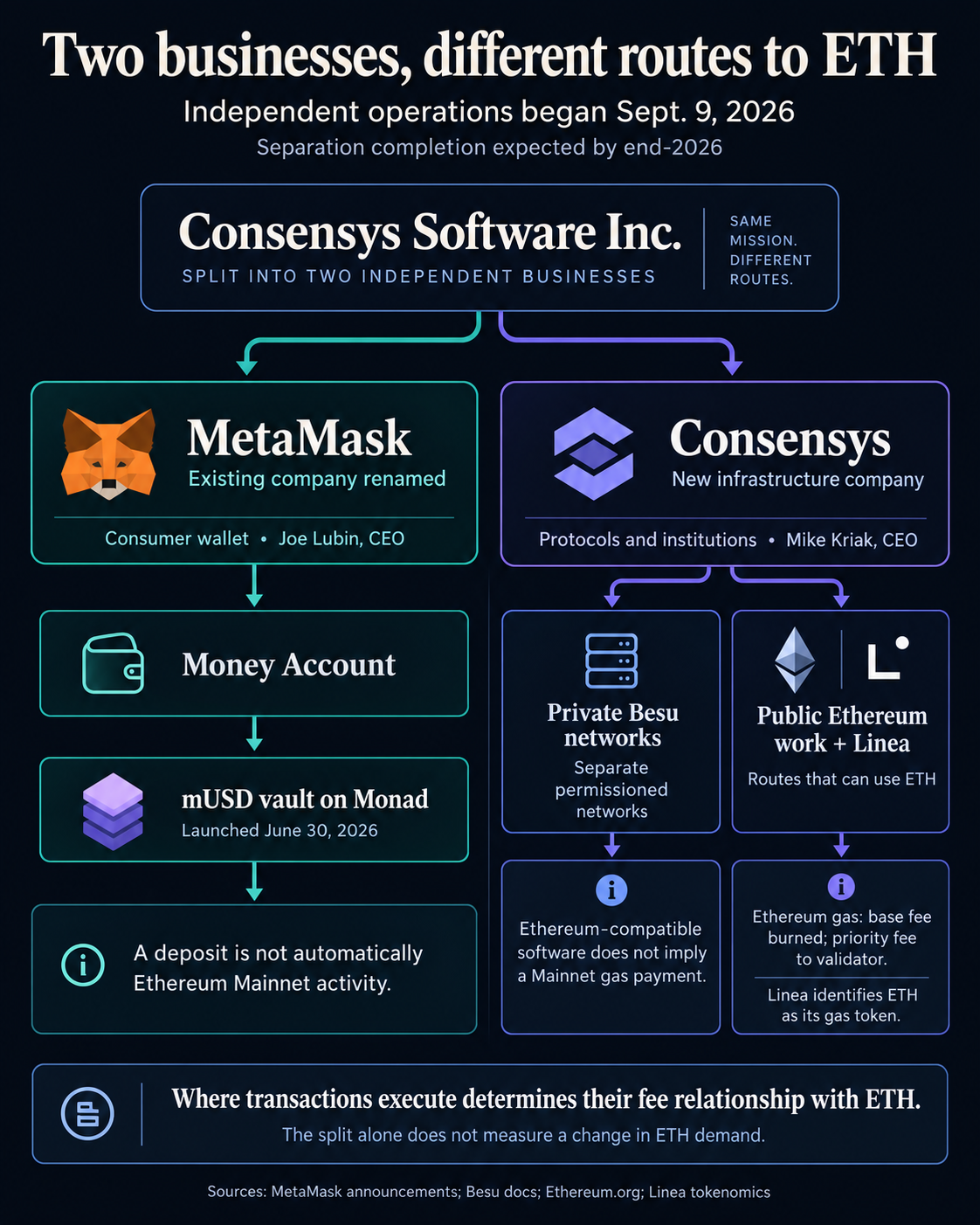
The clearest example is already inside MetaMask. Its Money Account runs on a separate blockchain, Monad, while the new Consensys will include software used for both public Ethereum and private institutional networks. The economic effect depends on where transactions happen and who receives the fees.
Under the announced structure, the existing Consensys Software Inc. continues as MetaMask. Its protocols and institutional infrastructure operations become a newly formed company carrying the Consensys name, including the Linea blockchain and software such as Besu and Teku. Joe Lubin leads MetaMask as chairman and CEO and serves as executive chairman of Consensys, whose CEO is Mike Kriak.
The businesses are set to operate independently, according to MetaMask’s announcement, with the separation expected to be completed by the end of 2026. MetaMask says the change requires no action from users and does not change their app, assets, keys or access.
The wallet has its own economics
A wallet is the interface through which users choose what to hold, trade and spend. That position gives its operator a business opportunity separate from the blockchain’s transaction charges.
MetaMask’s swaps guide makes the distinction visible in its fee breakdown. It lists a 0.875% MetaMask fee separately from the network fee and the exchange rate quoted for the trade. Those are different payments for different parts of the same transaction.
The wallet’s fee is therefore not a measure of Ethereum’s fee income. A larger volume of fee-paying swaps could expand the wallet business, but the effect on ETH still depends on the networks used, the work each transaction requires and the fee conditions there.
Money Account adds another route. Introduced on June 30, it converts deposits into the mUSD stablecoin and uses Monad as its home network. MetaMask says deposits enter a DeFi vault that allocates funds across lending markets. Veda provides the infrastructure and Steakhouse curates the vault.
This lets the consumer proposition center on a dollar balance and financial functions rather than on holding ETH. Customer sales of ether or departures from Ethereum remain unestablished. Counting every Money Account deposit as new demand for Ethereum block space would conflate the two networks.
The product’s yield also belongs in a different category from an ordinary wallet balance. MetaMask says returns are variable and the account is not a bank account or insured deposit product. Smart-contract, liquidity and protocol risks can lead to losses. Keeping control of signing keys does not remove the risks of the contracts a user chooses to enter.
The institutional side raises a similar distinction at the network level.
Besu is part of the infrastructure portfolio identified in the separation. Its private-network documentation defines a permissioned network as separate from Ethereum Mainnet and Ethereum testnets. Such networks typically have their own chain identifier and use proof-of-authority consensus, in which approved validators run the network.
An institution can therefore use Ethereum-compatible software without making each transaction an Ethereum Mainnet transaction. The software relationship is real; a Mainnet gas bill requires activity on Mainnet.
That is a different mechanism from the fee sponsorship CryptoSlate examined in August. A sponsor paying a user’s Ethereum gas bill changes who supplies the ETH, while the network charge remains. Moving execution to a separate network changes which system processes the transaction in the first place.
The distinction helps separate four activities that can otherwise be bundled into a single adoption headline:
| Activity | Economic route | What it establishes for ETH |
|---|---|---|
| MetaMask swap | Wallet fee plus a separate network fee | The wallet fee alone does not measure Ethereum demand |
| Money Account deposit | mUSD vault on Monad | The deposit is not automatically Ethereum Mainnet activity |
| Private Besu transaction | Separate permissioned network | Use of Ethereum software does not imply a Mainnet gas payment |
| Ethereum Mainnet transaction | ETH gas, divided between base fee and priority fee | Direct use of ETH for network execution |
Private infrastructure can be commercially important while having a different relationship with ETH from a public network.
The routes that still benefit ETH
MetaMask remains Ethereum-first while supporting multiple ecosystems, and the new Consensys retains public-network work alongside its institutional business. Those commitments preserve routes through which growth can benefit Ethereum’s native asset.
On public Ethereum, gas is paid in ETH. The base fee is burned, removing that ETH from supply, while the priority fee goes to the validator. Activity that uses this system has a direct fee relationship with the asset even when a wallet makes the process easier for the user.
Linea, which remains with the infrastructure business, offers another stated route. Its July 2025 tokenomics document identifies ETH as its gas token and describes a design allocating 20% of gas fees after Ethereum Layer 1 costs to ETH burning, with the remainder used for LINEA burning.
That historical design is not a current measurement of how much ETH is being burned. It does, however, explain why the institutional and protocol business cannot be treated as uniformly detached from ETH. Public networks, private networks and the consumer wallet have different economic connections to the asset.
For investors, the useful next evidence is the distribution of actual activity: which networks handle transactions, what fees they generate and how much of those fees reaches Ethereum or uses ETH. For MetaMask users, the immediate question is simpler: which service they are using, what it charges and which risks sit behind the balance shown on screen.
The separation gives the two businesses distinct operating mandates. Ethereum’s software can reach more users and institutions through both. How much of that growth benefits ETH will be determined by the transactions and fees that follow.